
Philosopher’s StonesTo the reader
To the Reader
Philosopher’s stones are the sclerotia of Psilocybe tampanensis, a small brown mushroom that Steven H. Pollock picked in a field near Tampa, Florida, in the summer of 1977. A sclerotium is a hard, knobbly mass of fungal threads that grows underground or in a culture jar. Pollock called these lumps “the philosopher’s stone”, after the substance that alchemists believed could turn base metal into gold. Today Dutch smartshops sell them as magic truffles, and the old nickname has spread to almost every truffle on the shelf.
This site follows that one species and that one name. It does not repeat the general guides to magic truffles that exist elsewhere. Each chapter answers a single question and lists its sources.
What the chapters cover
The first chapter is about the fungus itself: how a single specimen from a Florida meadow became a culture that is still grown today, what the mushroom and its stones look like, and why the claim that it was “found only once” is not quite right.
The second chapter traces the name, from the lapis philosophorum of medieval alchemy to Pollock’s phone call after he tasted his first sclerotium, a mail order business in Texas, a market stall in London in 2003 and the product pages of today.
The third and fourth chapters deal with use: the effects as health services and users describe them, and what laboratories have measured, set against how shops rank their strains. The fifth sets out the law in the Netherlands, the United Kingdom, Germany and the United States, each with a date and a source. The last chapter is a composite trip report, clearly labelled as such.
Three things worth knowing first
Philosopher’s stones contain psilocybin, the same substance as magic mushrooms. In the Netherlands fresh truffles are sold legally to adults; in most other countries they are a controlled drug, often under the same rules as mushrooms.
Strength varies. One laboratory study of truffles bought online found between 0.6 and 1.7 mg of psilocybin per gram of fresh sclerotia, a spread of almost three to one.
If you use them, do it in the Netherlands, in a calm place, with a sober person nearby, and never in combination with lithium. The effects chapter explains why.
The Tampanensis truffle as it is sold today, for adults in the Netherlands:
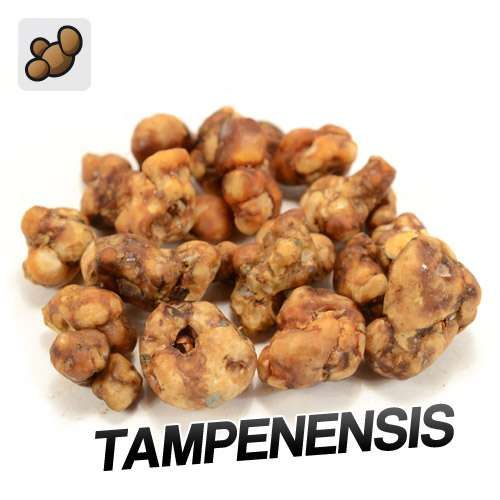 Tampanensis - Magic Truffles